
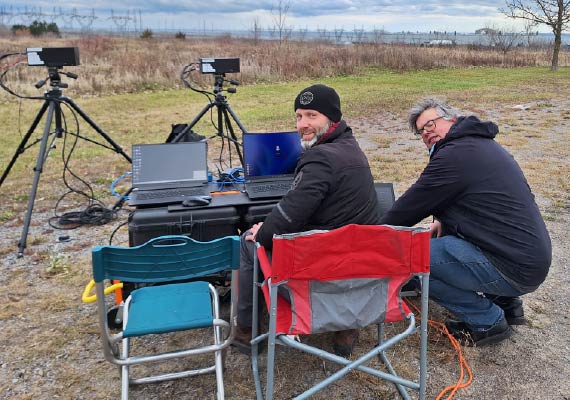
Drones are transforming our skies – from capturing breathtaking aerial shots and aiding emergency responders to conducting military surveillance and combat missions. But not all drones are welcome.
Unauthorized drones can disrupt events, breach privacy and threaten critical infrastructures like airports, military bases, parliament, prisons and power plants. In war zones, they can even be used as low-cost weapons against high-value targets.
A new portable technology developed by the National Research Council of Canada (NRC) and Defence Research and Development Canada (DRDC) cuts through the visual clutter of forests, crowds and buildings to zero in on drones that pose various threats—and that may not even register with traditional detection methods. The made-in-Canada technology will help enhance public safety in Canada and support military operations.
Cutting through the visual clutter
The NRC and DRDC have developed a technology to detect drones that is smaller and more accurate than other systems. Prototype testing is showing great promise, according to Dr. Marc-Antoine Drouin, Senior Research Officer at the NRC. As the sector lead for advanced machine vision defence and security in the Multimedia Analytic Tools for Security program, Dr. Drouin spearheads drone detection efforts along with a multi-disciplinary group of researchers and specialists from the NRC’s Computer Vision and Graphics team.
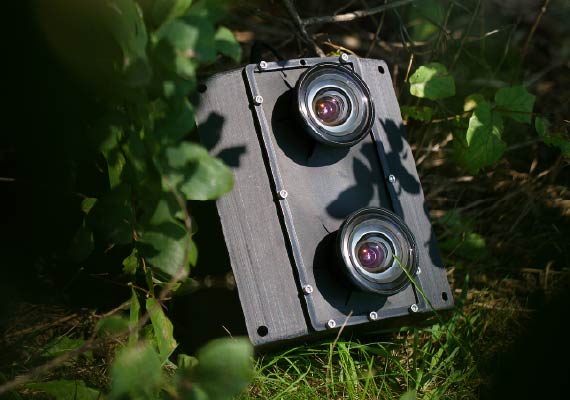
The prototype, tested in collaboration with DRDC and the Canadian Armed Forces (CAF), has clearly disrupted the status quo. “The system not only detects drones in places where no other technologies can, but it also does so without emitting radiofrequency signals that could reveal its location,” he says. The system is smart enough to differentiate between real drones and false positives such as birds or airplanes. And the technology is portable – it can fit in a car or small armoured transport and can even be carried on foot.
Two prototypes are now being field-tested with end users to ensure they integrate seamlessly into existing operations – paving the way for a market-ready product. The first, a wide-area drone detector, uses a scanning mirror to sweep across its field of view, delivering coverage over vast spaces. The second, a virtual fence, can easily be camouflaged and is designed for long-term detection of low-flying drones that use natural terrain to evade traditional systems, which are prone to blind spots in outdoor landscapes.
“One of the unique things we’re doing is looking at how the physics that keep drones in the air affect the environment around them,” says Dr. Drouin. “For example, we’ve successfully used propeller rotation speed to distinguish drones from other entities such as birds or flying debris.”
In a military context, the protection requirements and the threats are complex. “The rapid technology growth in the domain of uncrewed aerial systems such as drones requires development of new capabilities in drone detection with knowledgeable partners such as the NRC,” says Guillaume Gagné, Defence Scientist at the DRDC Valcartier Research Centre. Mr. Gagné looks forward to the continued collaboration between the NRC and DRDC to push the technology to the next level in the face of evolving threats.
Flying into the future with drone detection
The next step is commercializing solutions that meet specific client needs. To accelerate the adoption of emerging counter-drone technologies in a military context, the NRC and DRDC are collaborating with the CAF Joint Counter-Uncrewed Aircraft Systems Office (JCO) to find opportunities for soldiers to use these new systems in an operational context. Lieutenant-Colonel Chris Labbé, Head of the JCO, says that “the rapid deployment of advanced counter-drone capabilities is the only way to protect our forces and remain ahead of ongoing drone threats.” Soldiers are providing feedback to designers and scientists to help transition prototypes into usable systems.
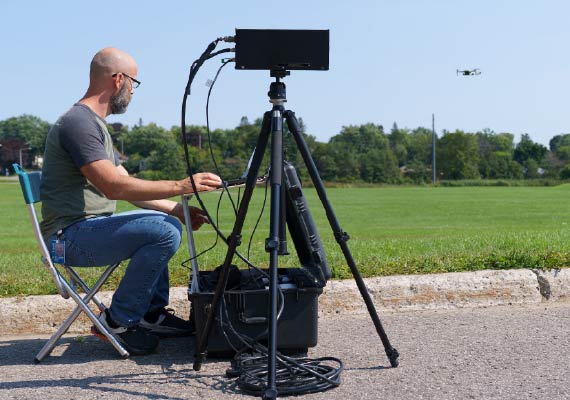
Adapting the system is a compilation of small things. For example, a prototype designed to sit 10 metres from an operating station may need more range to stay hidden if it’s on a rooftop. In some cases, installation speed is also of the essence. When it’s transported in the trunk of a car, the system may need to be installed in minutes. And of course, a critical element is getting the information to operators.
Dr. Drouin reports that tests have been conducted with multiple stakeholders in defence and public safety. “We installed the system in various locations and learned from their feedback what modifications we needed to make to ensure the best value. We doubled the detection range, added a radio link to communicate the detection of a drone and connected the system to command-and-control software,” he adds.
This innovative Canadian solution, developed through an NRC-DRDC partnership, has sent drone detection technology soaring to the next level while shrinking the system to a small and portable design. From this point, drones will remain on our radar.
Contact NRC
Media interested in speaking with an NRC subject matter expert about this initiative can contact:
NRC Media Relations
- Email: media@nrc-cnrc.gc.ca
- Telephone:
- 1-855-282-1637 (toll‑free in Canada only)
- 1-613-991-1431 (elsewhere in North America)
- 001-613-991-1431 (international)
Content provided by the National Research Council of Canada. View the original published article at NRC.canada.ca.