

Autonomous vehicles are becoming more common on our roads, bringing the promise of safer, more efficient transportation. But their reliance on AI also opens the door to new cybersecurity risks.
To address this challenge, researchers from the National Research Council Canada (NRC)’s Digital Technologies Research Centre are teaming up with experts from the University of Waterloo and policymakers from Transport Canada – Transports Canada. Together, they are testing how well AI-based decision-making systems in autonomous vehicles can withstand cyberattacks, without ever putting a real vehicle at risk.
From threats to solutions
AI algorithms are transforming the way autonomous vehicles navigate, enabling them to make split-second decisions in complex situations. Still even the most advanced systems can be vulnerable to threats that could compromise public safety and critical infrastructure. To explore these risks, the team built a virtual testing environment that mimics real-world driving conditions.
“We wanted to build a space where we could safely simulate various threats on these systems, so we could figure out how to protect them,” says Dr. Pulei Xiong, a research officer with our Digital Technologies Research Centre. “This research is essential for improving the safety and reliability of self-driving technology.”
The project has been carried out in 3 phases, supported by our AI for Logistics program. First, the researchers evaluated the performance of selected AI algorithms under different driving conditions. Next, they created a prototype of the virtual testing space to simulate various cyberattacks.
“We have been able to evaluate how autonomous vehicles respond to threats like data manipulation and network intrusion, without ever putting a real vehicle at risk,” explains Dr. Nasser Lashgarian Azad, a professor in the Department of Systems Design Engineering at the University of Waterloo. “We watch how the vehicle’s decision-making system responds and learn where the weak points are.”
Securing the road ahead
Now in its final phase, the project team is focused on creating custom defence strategies to protect AI-based systems from cyberthreats. These strategies are tested in the virtual space, with results regularly shared with Transport Canada, which plays a central role in regulating autonomous vehicles in Canada.
The collaboration has also provided meaningful opportunities for graduate and undergraduate researchers to take part in real-world cybersecurity testing, helping them develop practical skills and explore careers in the field.
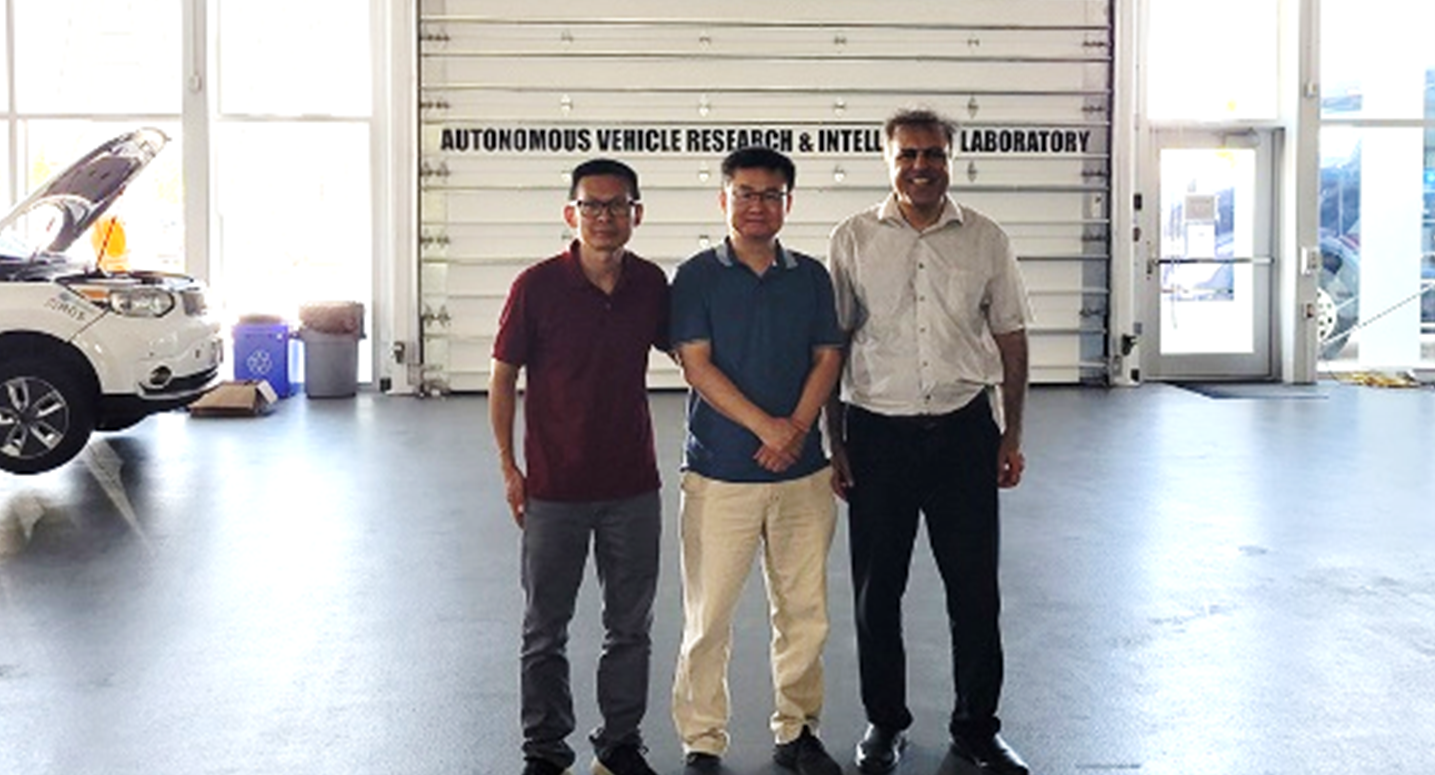
Looking ahead, the team plans to use the virtual testing space to assess the security and reliability of robotic technologies in healthcare settings. As autonomous technologies continue to evolve, their work is paving the way for more secure and resilient systems across transportation, healthcare and beyond.
The research team consists of Pulei Xiong, Nasser L. Azad, Saeedeh Lohrasbi, Kimia Dinashi, Samyar Goodarzi, Farid Mafi Shourestani, Philippe Andrecheck , and Sarah Chippure.
This research was supported by grants and contributions awarded through the Collaborative Science, Technology and Innovation Program, administered by the NRC’s National Program Office.
Check out our web page if you would like to engage with our cybersecurity experts and see our focus areas.
Content provided by the National Research Council Canada. Read the original story here.